It Needs Repeating (c)

Now I have to digress just a little because the intimacy between God and Moses at the time of his death is just too exquisite to pass over. And it has me thinking…I wonder what Moses must have thought and what emotions rushed over him upon hearing straight from God, “but you shall not go over there” (Deuteronomy 34:4). Was he disappointed and sad? Or was he ready to trade the temporal trappings of this life for the eternal embrace of His Jehovah God? I lean to the later mindset because the next verse (5) simply says, “So Moses the servant of the Lord died there in the land of Moab, according to the word of the Lord.” 

Don’t miss that. Moses, the servant of the Lord, died according to the word of the Lord. Just as God breathed life into Adam and subsequently into Moses and each of one of us, it is according to His word when, where, and how we die. That should bring us hope and peace as we face the uncertainties and cruelties of this world, and it should bring great comfort as we face the one certainty in life: death.

Then verse six gives us what I think is one of the most tender moments in the entire Bible. “And He…,” that’s a capital “H” meaning God. “And He buried him in the valley in the land of Moab, opposite Beth-peor; but no man knows his burial place to this day.” Have you ever noticed that verse before? I want to just stop for a few moments and let that narrative soak in. 

God personally buried Moses! Can we even imagine the mighty hand of God carving out a burial plot, gently placing the lifeless body of His beloved servant in, and then closing the place up? Closing it up so well, that no one has ever found the resting place of Moses. Something that would take men hours to do took only a moment of God’s time.

But what a moment! Tender! Intimate! Holy! 

Oh that I would have a fraction of that kind of intimacy with my Creator! Will my epitaph read, “Elaine, the servant of the Lord.”? Or will it be more important that I was a loving wife and mother or a powerful author or a great friend? None of those labels are bad. And it’s not that they shouldn’t be on one’s gravestone. But if all I get when I die is one line, what do I really want engraved on that one line? It comes down to perspective and whose perspective.

I think perspective is what Jesus was talking about when He said I should hate my father, mother, sister, and brother if I want to be His disciple (Luke 14:26). Jesus isn’t contradicting His own law here, to honor father and mother (Exodus 20:12). He is simply putting those relationships in perspective. When I get to the place that I love Jesus so much that I take my cross and follow Him (Luke 14:27), and I am willing to lay down my life for Him (Luke 14:26), and I give up all my possessions for Him (Luke 14:33), then all my other relationships will seem like hate in comparison. Moses did that. He was a son, husband, father, and a brother. He was a leader and a friend. Those were important aspects of his life ordained for him by God. He was responsible for those relationships.

But at the end of his life, the crucial thing, the most important relationship commemorated about him by the Creator of the Universe was, “Moses, the servant of the Lord.”

I don’t get to slack off being a loving wife and mother or a great friend. And I don’t get to lay down my writing pen. In fact, a big slice of being a servant of the Lord is excelling in those relationships and endeavors God has given me. But if I don’t keep a God perspective in the mix of all that, then I am no longer serving the Lord. I am serving myself, in which case my epitaph, my one line, might read, “Here lies Me, Myself, and I.” 

The Bible makes it clear. It is a choice. Which one line do I want? Which one do you want? 

Discussion

  • Name some of the instructions God gave to Joshua in the battle of Jericho and explain why carrying out these instructions would need strength and courage. (Reference Joshua 6) 
  • Name specific ways we have learned to love each other and explain why we need strength and courage to successfully live out loving one another.

It Needs Repeating (b)

Would these eleven be ready for the unknown, the unthinkable? Could they face insurmountable odds like their forefathers did? 

  • Would they remain God’s friend like Abraham? 
  • Could they be steadfast like Joseph? 
  • Would they lead grumbling followers like Moses? 
  • Could they be strong and courageous like Joshua?
  • Would they be men after God’s own heart like David?

Each of these ancient men was enabled with specific talents by God for super human tasks that only God could ordain and bring the subsequent success. Would Jesus’ disciples go and do likewise?

I want to spend some time on a particular favorite of mine, Joshua. A little background will help us get a grasp of the full impact of the instruction laid out before this remarkable man of God.

The children of Israel were slaves in Egypt for more than 400 years when God miraculously rescued them from that bondage through his somewhat reluctant servant, Moses. Over time and through many public and private lessons, Moses became less and less hesitant and more and more valiant as leader over Israel. Now every great leader needs a trustworthy aide. For Moses, that man was Joshua. He served Moses as his attendant from his youth (Numbers 11:28) and led Israel into many battles as they journeyed through the desert to the land God promised them (Exodus 17:9-13).

Finally, the Israelites were near their final destination, the Promised Land, and God told Moses to send out twelve chosen men to spy out the land. Forty days after the twelve spies (Joshua being one of them) left to check things out, they returned with all kinds of wonderful produce and reports of a land flowing with milk and honey. Hmm…mmm! After all this time with nothing but manna and quail, the Israelites took off immediately and entered into the land God had promised them, right? Sadly, no. Ten of the men also reported to Moses and the people that there were giants in the land and they felt like grasshoppers in their sight (Numbers 13:33). This frightened all the people and confused them on what they should do next. 

Two of the spies, Joshua and Caleb, tried to reason with the masses. Yes, there were giants. And yes, there were many cities to conquer. But God would enable them to overcome these obstacles (Numbers 13:30). The people decided to go with the majority. Needless to say, majority rule does not necessarily mean having the right answer. There was only one yes or no question on this test God put before His people. It should have been an easy question to answer in light of all God had done for the nation of Israel. 

Can we trust God and enter into the land He promised our father Abraham? The correct answer is, “Yes! Pack up and move in!” Instead, the Israelites complicated the question with man’s reasoning, logic, and majority opinion. They answered, “No! Let’s go back to our tents and figure out some other way.”

The Israelites got this simple yet critical yes or no question wrong and it cost them everything. They would wandered in the wilderness for another 40 years until the entire generation who went with the majority vote died out. Except, that is, for Joshua and Caleb. Because of their correct answer to this yes or no question of trusting God, their lives were spared. In fact, God used both of them in miraculous ways to conquer the land meant for His people Israel.

The naysayer generation eventually dies out, and because of his own lapse of faith, and in reality, God’s providence, Moses will not be going into the Promised Land. God takes Him to the top of a mountain, shows him all the land, and tells him he will not be going any further.

Moses dies.

Discussion

  • We are told in I John 2:6 that the lust of the flesh, the lust of the eyes, and the pride of life sums up all that is in the world. How would each of these hinder the mandate to love one another? To Christians in general? To you specifically?
  • Lust of the flesh
  • Lust of the eyes
  • Pride of life

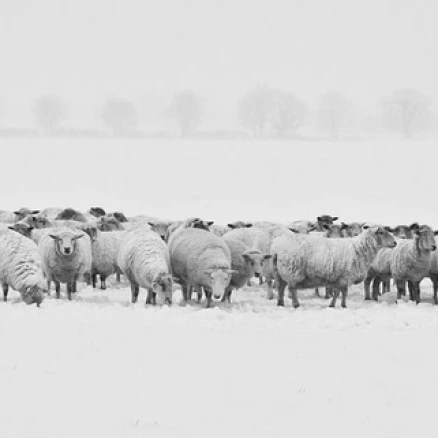
Psalm 23: Fearful Sheep

Even though I walk through the valley of the shadow of death,
I fear no evil, for You are with me.

  Psalm 23:4a

What an accurate picture of our current world madness! Many thousands of people are touched by the “shadow of death”. Fear has gripped the world and, for some, God may seem far away!

Isn’t it interesting that in our language the idea of “valley” is used as a metaphor for a bad season of a person’s life, because most valleys that I have seen, like the ones throughout America, are quite breathtaking. If I stand on top of a hill or hike on a mountain pass and look out, the valleys below are beautiful whether they are lush green or desert. The sure vastness of the scene is enough to take my breath away. I stand very still and am quiet. I want to hear the river rushing on its course below me. I want to imagine the wildlife hanging out in the valley and wonder what their day is like. I scan the sky for the eagles and hawks soaring high above the valley looking for their next meal. I simply want to take the whole valley in. In short, I am in awe of what lays out before me.

So why the negative in equating valleys with all things bad in our human experience?

A valley is a valley because hills and mountains surround it. Beautiful and majestic at first, these massive boundaries can become haunting like sentries of a prison as time goes by. The valley may be massive, but the claustrophobic feel of said “prison” if you are lost and it is very real when there seems to be no way out day after grueling day…after grueling day. This is especially true if you are in a valley you are not familiar with. Even the most lush valley will become tiresome if there is no obvious way of escape. The valley may seem like a fine place to hang out at first and even be pleasant, but as time passes, an exit to somewhere else is important to one’s sanity.

If there is no exit or the exit is not easily found or seems too hard to access, despair will ensue and fear can overwhelm even the most stout of heart.

In the valley you cannot see beyond the formidable mountains. You cannot see the whole picture of what is really around you and the truth of reality becomes blurred. All you know is the valley. There may be civilization just on the other side of the mountains, but you cannot see it. You may even know it is there, but like a dream, you cannot quite fathom your life there because you are “stuck” in the valley. The valley consumes you and consumes every minute of your day.

You can actually be in one of these massive valleys and not realize that there is anyone else there; that there is anyone looking for you or trying to help you. Often in rescue stories you read of hundreds of rescuers being sent out, even planes and helicopters being used and yet the lost parties believe they are all alone and have no one looking out for them, no one to bring them home.

These reasons and more are why our shepherd, King David, uses a valley to describe the shadow of death.

We all have experienced this shadow of death. If you are reading this you obviously have not died yourself. But the shadow of death has been your experience. Death of a parent or grandparent or a child. Death of a friend or even a coworker we barely know will bring death’s shadow to the door of our soul.

We cannot escape it. We cannot put it off. And we have no say in it. Death is the one thing we humans cannot control.

Some of us have experienced our own shadow of death; the confirmation of cancer or heart disease brings the shadow swiftly into our path. Even the prospect of these diagnoses and the ensuing tests bring us body and soul deep within this valley of the shadow of death.

And even in this, David boldly proclaims, that we do not have to fear!

…for You are with me!

Our God is just as much with us in our valleys as He is with us on our mountain tops! It is sometimes hard to accept and believe, but it is God, Himself, that put us in that valley, but He is with us through every minute of every day that we walk in the valley. Fear wants to overtake us, but in Jesus the Christ, we not only can conquer that fear, we can thrive in that valley! Not because of any special skills or attributes we may utilize, but because God’s compassions never fail and His faithfulness is GREAT!

For the LORD’s lovingkindnesses indeed never cease, for His compassions never fail. They are new every morning. Great is Your faithfulness.

 Lamentations 3:23

It Needs Repeating (a)

Anyone who has attempted to master an art, like music, drawing, or sculpting, knows the basic elements have to be taught over and over again. I remember my longsuffering piano teacher repeating over and over, “Now, Elaine keep your wrists high, your fingers curved and light over the keys. And don’t slouch.” That was more than 40 years ago and only two years of lessons, but even today if I sit at a piano I will keep my wrist high, my fingers curved and light over the keys, and I never slouch. Why? Because Mrs. Cartwright repeated, both in word and in application, this essential hand and body position over and over during my lessons. She knew droopy wrists and heavy fingers hindered excellence in piano playing. And she should know; she was a master on any keyboard.

I didn’t stick with the piano lessons. I was convinced I should play the violin. That lasted six months. Then I was convinced I should play guitar. That lasted two lessons. I quit when I was informed I had to trim my fingernails. Pathetic, I know. What was my problem? I wasn’t willing to listen to instruction, implement needed changes, or do the hard work of repeating basic elements over and over again. I wanted to be a master musician with minimal practice and little change to my life. Needless to say, I have never mastered any instrument. Good intentions did little good. My choices determined the level of mastery or lack thereof I would experience in the music world.

Sometimes I have the same attitude when it comes to mastering the art of loving one another. I want to love, but I prefer to keep the lessons simple and the practice time short. After all, shouldn’t loving one another come naturally for me? Why do I have to practice? And why does it have to be so hard and time consuming? After all, I have a life to live and a schedule to keep. I don’t have time to master the art of loving my brothers and sisters in Christ. Bottom line, it has been my choice to be average Josephine One Another.

But God (there’s that phrase again) is never content in letting me be an average one another.

His goal is excellence in me and in you. Just like Mrs. Cartwright, He patiently repeats the lessons in basic one another living, but He doesn’t give me the option to quit. As long as He gives me breath, the lessons continue. In the past, I have chosen not to listen and not to practice, but the burden that came with that choice was always heavy and the cost too high. Finally, I’ve learned to not only listen to God’s lessons, but to pay special attention and take thorough notes, especially when He repeats Himself. In this book, we have been studying and applying the individual words and phrases from a time when our Master Teacher, Jesus, repeated Himself to His eleven closest students. It was His last earthly classroom in the Upper Room. It was a tender time and yet a time of confusion and uneasiness. Things were going to change, dramatically.

Discussion

  • The scene of the Upper Room is documented in all four Gospels. What attitude is recorded in Luke 22:24?
  • What similar attitude took place earlier in a conversation between two brothers and Jesus? Refer to Mark 10:35-45
  • How might this attitude in the disciples hinder their execution of loving each other? 
  • What similar attitudes rob you of the blessing of loving and being loved by one anothers? How so?

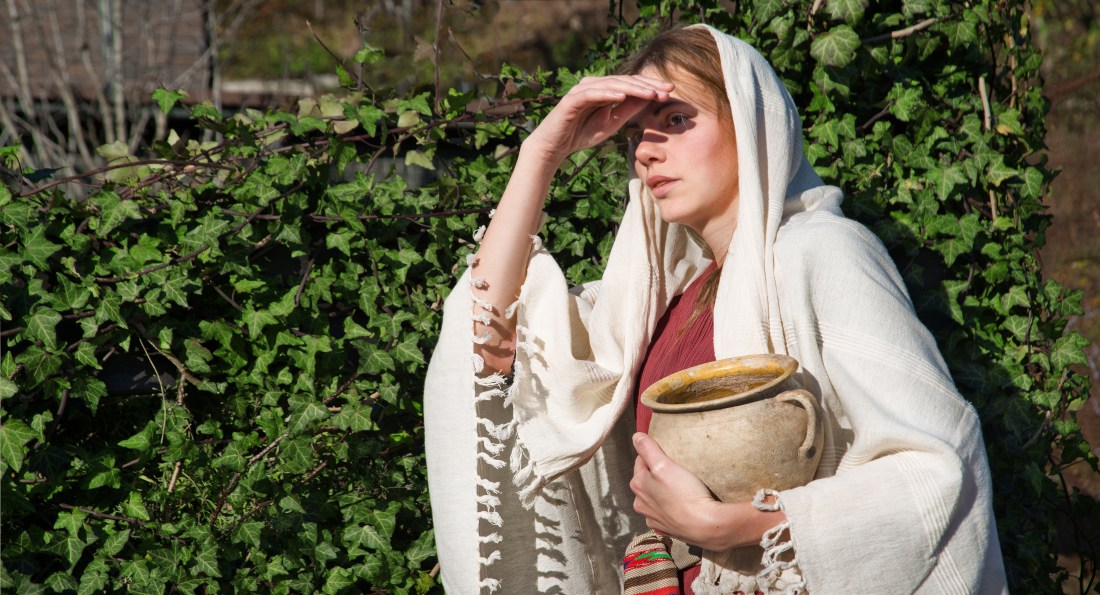
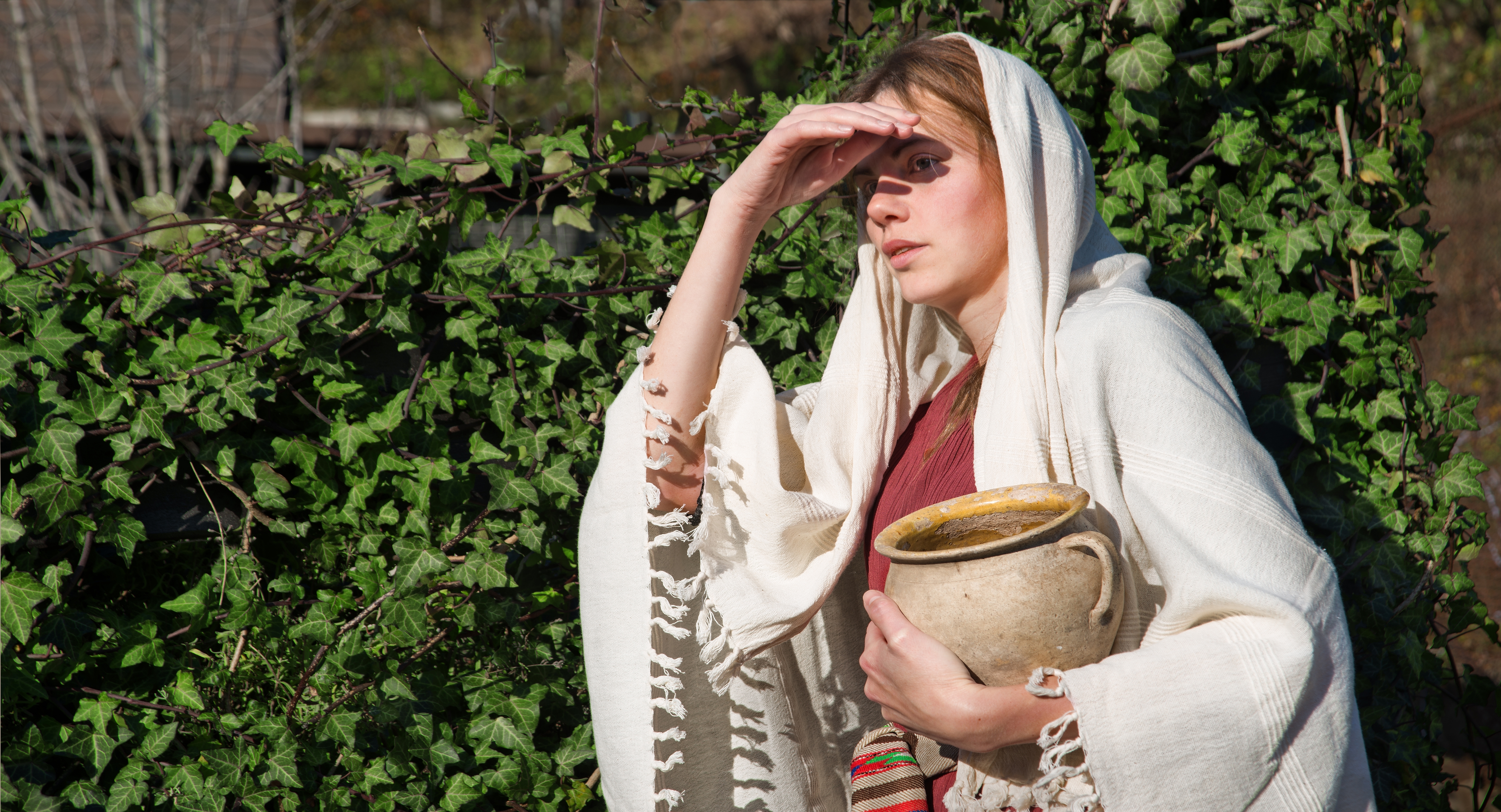
Seeking Abigail (Scene 9)

It became known all over Joppa…

Acts 9:42a

“It cannot possibly be true.”

“Ah, but it is!”

“She has been seen, walking to the well.”

“It was someone else who looks like her. Eyes play tricks.”

“Do ears and touch play tricks also?”

“You have seen? You have heard? You have touched?’

“No. But Grandmother has.”

“Egh. A grandmother! Old minds believe what they want to believe.”

“My grandmother does not lie.”

“I do not say she lies intentionally. I say only…”

“Come with me. See with your own eyes. Hear with your own ears.”

“I do not have time for such silliness. The market waits.”

“You are afraid it is true. That is why you will not come.”

“I am not afraid of a hoax! I simply do not…”

Abigail watched from the corner of her booth as young Rachel pulled a reluctant Hannah across the market and then turned down the alley leading to… She shuddered. It cannot be. It must not be. 

 “If it is true, then…” Her voiced apprehension trailed off.

“Then…” A gentle hand touched her arm. “…what?”

Abigail turned to see Chloe beaming at her. The wealth of questions she had rehearsed the night before flew from her memory, but it did not matter. One look at the woman standing before her spoke a thousand words and answered volumes of questions. 

“She lives?” It was half a question and half a statement of fact.

“She does.” Two wrinkled hands enveloped hers. “Come and see.”

Abigail shook her head. An immediate disappointment shadowed the twinkling eyes staring up into hers. 

“I do not need to see.”

“But, you must…”

The young girl put a tender finger to the old woman’s lips.

“I do not need to see because I believe you.” She smiled. “You would not lie to me.”

“Indeed, I would not.” The disappointment vanished. “You believe?”

“I believe she was dead and now she is alive.” Abigail shrugged. “I do not know yet if I believe a man can do this.”

“Ah!” Chloe clasped her friend’s hands in hers again. “A man cannot do this. Only God can do such a thing.”

“But it was your apostle…”

“No! Not a man, not even an apostle, but in the name of Jesus the Christ, the Son of Most High God!” Chloe stretched both their hands up toward the sky. “This you must now believe.”

She tugged for her young friend to follow her.

“But my booth!” Abigail hesitated. “Father will tan my hide.”

“The market and fathers can wait.” Chloe shouted. “Eternity will not!”