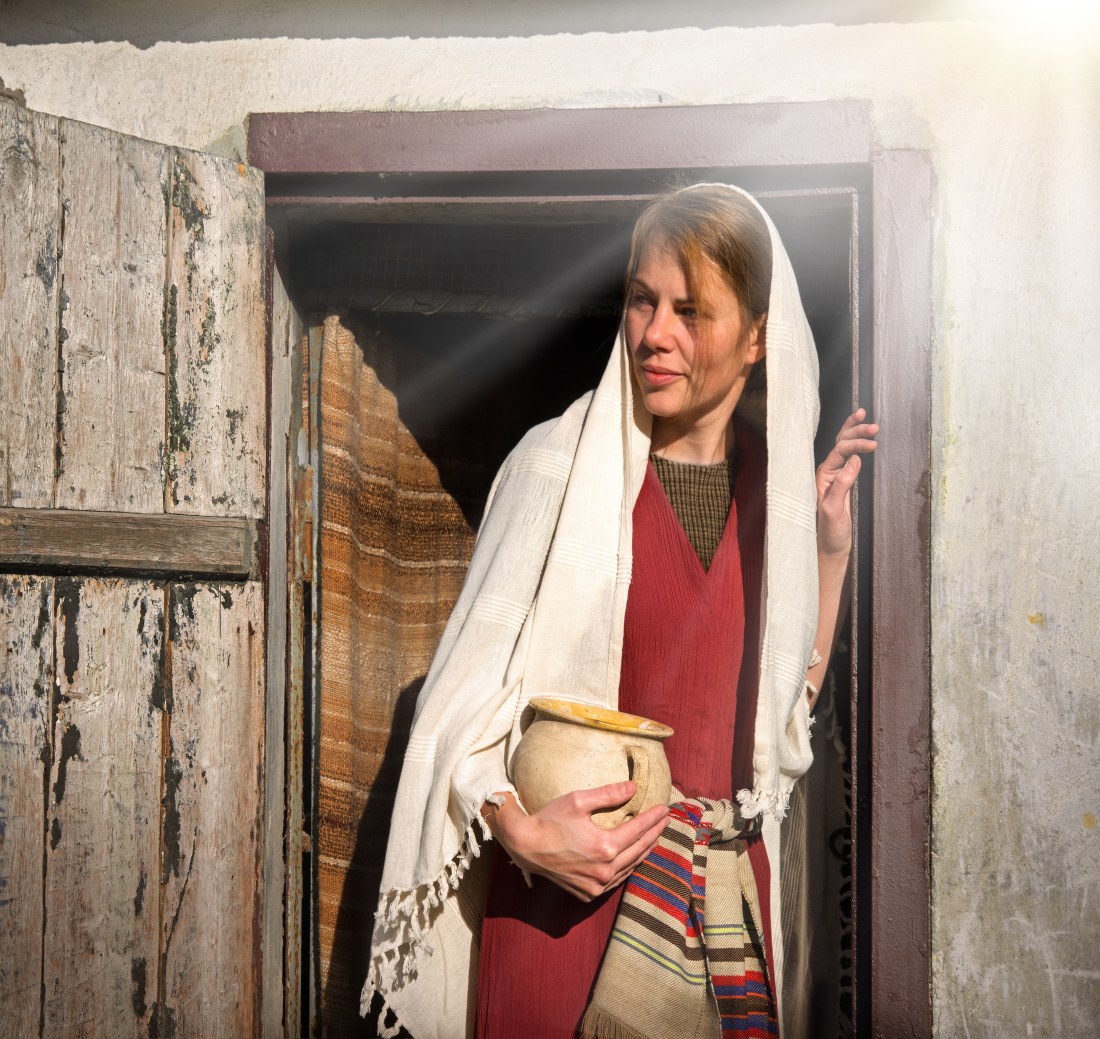
Seeking Abigail: Scene Three

Since Lydda was near Joppa, the disciples, having heard that Peter was there, sent two men to him, imploring him, “Do not delay in coming to us. Acts 9:38

Chloe hesitated before taking the few steps around the corner. She had not seen Abigail since their collision with Seth, and she was not sure how her unannounced visit would be received. She hoped her order for new cloth would ease any tension. A quick prayer on this matter was all she had time for as the crowd pushed her forward.

“Jesus, I do not really understand how all this works.” Chloe’s lips moved but no sound came out of her mouth. “But please help me help my friend.”

The crowd pressed in all around and Chloe wondered how she would successfully navigate through the web of arms and legs to get to Abigail’s stall. But then a hand cradled her elbow, causing her to jump, and she nearly dropped the fresh new figs which were her barter for the new cloth. 

She glanced up and sideways at a grinning Judah who easily moved them both through the crowd. He stopped at a small open space between a potter and a weaver just a few stalls away from where Abigail sold cloth.

He said nothing but simply helped her juggle a few wayward figs back into her basket. When she was satisfied her fresh cargo was secure, she glanced up into his worn face.

“You look tired, Judah.”

“Is it that obvious?”

She nodded. “You must find time to rest. You cannot carry the burden of the Way alone.”

“Is that advice you keep or just give away?” He snatched a fig and popped it in his mouth. Chloe’s slap just missed. “You have…not…been home…” He gulped. “…since yesterday.”

Chloe looked away and dabbed at a tear with her free hand. “There is much to do.”

“I know.” Judah cleared his throat awkwardly. “But we must have faith.”

“Will Peter come?” She continued to stare blankly between the two stalls. “And what if he does? Can he really bring her back to us?” The whir of the potter’s wheel and the low whistle of the spindle jumbled together just like her mind.

“If God wills.” 

Chloe turned back to face him and sighed. “This is all so different…wonderful and strange all at once.”

“Yes it is. Every day brings new and wonderful changes, even in sadness.” Judah snatched another fig and popped it in his mouth. “Where…are…you…taking these?”

“To Abigail.” She covered the basket with her apron. “If there will be any left!

“Are you sure you want to face her? She was still seething last night even though my uncle was not that distressed about the cloth.” 

“You know this?”

“Why…yes.” Judah moved them back into the crowd. “I went to their home last night with Seth to explain what happened.”

“What?” 

Chloe desperately wanted to know more, but the noise of the crowd made that impossible. Besides, before she knew it Judah had them standing in front of Abigail’s stand. He waved vigorously above the small crowd gathered ahead of them. A loud “Not now Judah! I am busy!” was shouted back to their position.

Judah bent down to Chloe’s ear level. “I think you should come back.”

She shook her head. “No. I will wait.”

“That one is stubborn.” He nodded in the direction of Abigail.

Chloe stood firm cradling her figs. “And so is this one.”

 “I will send word to you as soon as Peter arrives.” He turned to leave.

“Peter is coming?” Chloe pulled him back hard toward her, almost dropping the whole basket of figs. “Why did you not tell me this sooner?”

“I just found out myself when I saw you.” Judah’s eyes were lit with excitement. “That’s what I came to tell you.” He stood tall and looked up into the sky, clapping his hands.

A “Judah get out of here! I do not have time for you now” was barked over the heads of the bartering women ahead of them.

Chloe pulled him down to her eye level. “Well, you did not have to take all day!”

Judah patted her head. “You exaggerate old woman.” He grabbed a handful of figs and darted back into the crowd.

“Judah!” Chloe hollered after him. Chloe stared at her depleting supply of new figs and then back out into the crowd. A lone tear made its way down her face.

She absently twirled the figs in the basket and took a step forward. “He is coming here.” She popped one in her mouth. “Can…it be? Will Tabitha…walk among…us again?” She took two more steps. “The great Apostle is coming here.” She laughed out loud. 

“Who is coming here?”

Chloe stared up into the questioning eyes of her young friend. She handed the bewildered Abigail a fig.

A New Thing (e)

Faulty Thinking #4 

The disciples desperately longed for new, but they assumed these new things Jesus talked about would fit into their same old existence. 

They were comfortable, thank you very much, and didn’t really want to stir things up any more than necessary. So they expected this new thing would fit into their old lifestyle. Jesus called it pouring new wine into old bottles.

And no one puts new wine into old wineskins; otherwise the new wine will burst the skins and it will be spilled out, and the skins will be ruined. But new wine must be put into fresh wineskins. Luke 5:37-38

 The results of new wine in old wineskins aren’t good. For example, it wasn’t long after Jesus died and rose again that Peter went back to his old way of life. He went fishing and his fellow disciples went with him (John 21:3). They fished all night and didn’t catch a thing. They assumed that once they met Jesus, they could go back to the way things were and everything would be normal again. They assumed wrong.

Even my vast imagination cannot fathom the depth and diversity of emotion that must have gripped Christ’s followers after His crucifixion and resurrection. Remember, in one week’s time, his followers went from being in the top ten of most influential groups, to being the most wanted by their own religious leaders, to being the most disbelieved by everyone. Under those circumstances, I think any one of us would fall back to what was safe and comfortable, just like these men. 

But Jesus wouldn’t let them stay there nor does He let us. To an outsider, and sometimes even to us, it may seem cruel when Jesus takes our hand and leads us back to the scary new thing. After all, isn’t safe and comfortable the crux of the American dream? Life isn’t supposed to be complicated.

Now, if it is tumultuous because of our own disobedience and sin that is something quite different. Even then…maybe even especially then, Jesus longs to pull us back to the new thing. But He won’t until we confess sin and want to go back to the new thing. The Master Teacher never forces us to do anything. He will apply a great deal of pressure, and He will never leave us or forsake us, but He never forces us. He could, but He doesn’t. Amazing!

Anyway, here at the Sea of Galilee, Jesus wasn’t being cruel and insensitive to allow His followers to fish all night and catch nothing. He was showing them, through life experience, that if they went back to the safe and comfortable, it would be empty. He could have told them this. Oh wait! He did tell them over and over (Matthew 6:25-34), but we humans learn best with experience.

He also knows we need encouragement and strengthening as He leads us out of the safe and comfortable back to the new thing. Jesus did just that on the beach. His students came up empty, zero fish. They were ready to give up. They thought they were alone. Their faulty thinking was taking over. You see, their net didn’t have to be empty. They didn’t need to give up. They didn’t need to be alone. 

It took them a moment to figure out it was Jesus on the beach. How did they figure it out? He told them to cast the net one more time on the other side, which they did, and they couldn’t haul the net in because there were so many fish (John 21:6-8). 

Jesus is so practical. He had a deep challenge for Peter (and the others listening in), but He knew they needed to rest a while and eat first, “Come and have breakfast” (John 21:9). He treated them in a familiar way: “Jesus came and took the bread and gave it to them, and the fish likewise” (John 21:13). And He waited for them to finish breakfast. Isn’t that just like Him! He knows our physical, mental, and emotional frailties. He doesn’t just brush them off and tell us to suck it up. He cares for us. He meets our needs. He strengthens us. Then He reminds us of the new thing and His role for us in it.

John 21:15-17 is the famous love debate between Jesus and Peter. We will go into this in more detail in a future chapter. For now, I just want to point out that Jesus is trying to get His student, Peter, to understand just how hard this new thing is going to be. Peter is flippant about it at first, but Jesus won’t let him continue with that attitude. He wants Peter to know, in no uncertain terms, that he can never go back to the safe and comfortable. Jesus also wants him to know this new thing will be worth it all. Amen!

Faulty Thinking #5

The disciples assumed life was going to get better if they just kept following Jesus. This wasn’t completely faulty thinking; it was more like incomplete thinking (Matthew 21:8-11). Being with Jesus was amazing and certainly eventful. The movement was growing! They were finally in Jerusalem and had unprecedented support 

Portrait by Janet Heyworth

Grant it, they were getting a little antsy about the timing of Rome being overthrown and Jesus being the earthly king. And it was a bit disconcerting to hear all Jesus’ talk about going away and they can’t follow. But in their wildest thoughts and contemplations of the future, the disciples could not have even come close to what unfolded that night after they left the Upper Room and the days following.

They assumed life was going to get better. They were sort of right this time, but they had no clue the price that would be paid for the better to come and how much they would need one another. They didn’t do it perfectly, but they did it. They had to! 

I wonder what it will take for us to “have to” love one another?

Discussion

Let’s think of a brand new way (I mean totally new way) to bless an old one another relationship. This time let’s think outside our families and think of our one another friends. Maybe it will be someone we haven’t seen for a while or someone we’ve just drifted apart from for no real reason. Or maybe it’s just someone we are so comfortable with, we’ve kind of taken them for granted. Whomever God brings to your mind, bless away! Again, don’t be boxed in with monetary means of blessing; think beyond that.

A New Thing (d)

Faulty Thinking #2

The disciples filtered much of Jesus’ teachings through human reasoning, not just in regard to a political victory, but in their everyday lives. 

Just a few days earlier Peter asked Jesus how often he should forgive his brother. He thought seven times was pretty generous, but Jesus told him to forgive seventy times seven.

Then Peter came and said to Him, “Lord, how often shall my brother sin against me and I forgive him? Up to seven times?” Jesus said to him, “I do not say to you, up to seven times, but up to seventy times seven. Matthew 18:21-22

In the Greek language the idea is to forgive “countless times” times seven, in other words to forgive an infinite amount of times. This was way beyond Peter’s understanding and he would soon learn that his idea of loving one another was quite different from Jesus’ example. Washing his feet was only the beginning of just how far Jesus’ love extended to Peter. Eventually, Peter wept bitterly over this realization and so should we.  

Instead I find myself reminding God just how lucky He is that I am on His team. Oh, I don’t come right out and say those exact words; that would be sacrilegious! But my heart-speak sounds a lot like that Pharisee who looked down at the tax collector, “God, I thank you that I am not like other people…” and on he went… “Blah, blah, blah, blah, blah.” (Luke 18:11) This guy really thought his own efforts made him better than all the others around him. He thought he was a pretty good guy. 

Sometimes I think I am pretty good gal. Come on! Admit it. You do too! After all, we do have some pretty awesome qualities. We’re smart and, of course, our kids are brilliant. We’re compassionate. Didn’t we drop in our spare change at every Salvation Army bucket we passed at Christmas time? We’re calm and level headed except, of course, when the idiot behind us stepped on the gas instead of the brake. But, I ask you, who could be calm in that situation? 

Obviously, we’re hospitable…if we have at least two weeks to plan and the event is limited to six couples. (Sorry, no singles. We just don’t know what to do with you.) And, we must mention, we are loving. Women are natural nurturers, you know. Of course, we are more loving when you give us what we want, behave the way we expect, and let us do what we want, but hey, those are just details. 

Like Peter, it’s painful when God shines His holy Standard up to those so-called good qualities we hold to so tightly. In fact, it should be so painful that we weep. God doesn’t want an offering of all our good qualities. He doesn’t need them. He wants a broken and contrite spirit. 

The sacrifices of God are a broken spirit; A broken and a contrite heart, O God, You will not despise. Psalm 51:17

Faulty Thinking #3 

The disciples figured they could obey this new command within the framework of their current religion. 

This diverse group of men had one thing in common: they were Jews. As such, they were raised and lived in accordance with The Law of Moses and under hundreds of extra manmade religious rules. They also lived under Roman law. If there was one thing they knew about, it was following laws and rules. These students of Jesus assumed they would find the assistance they needed to obey this new command, to love one another, somewhere in all that verbiage. They assumed wrong.

This is evident throughout the New Testament epistles. The early church and its leaders, including the original disciples, struggled to love. Even a simple act of fellowship, sharing a meal together, caused quite the stir. Paul spends a great deal of time on this question. Should a true believer, a one another, eat meat offered to idols (I Corinthians 8:4-13)? 

Before Jesus…before the cross…before grace…for a Jew to eat meat offered to an idol was not only a religious sin, it defiled him or her and it was a political disaster. How could any of the eleven disciples back in that upper room know that in just a little while, not only was it going to be okay for them to eat food offered to idols, they were going to be eating that food with their uncircumcised Gentile brothers AND women would sit at their table. Talk about shock waves.

This is not something we easily relate to, but for the early church, it was as charged as our modern debates over Bible translations. Indeed important stuff and just as important as meat offered to idols. But as Paul through the Holy Spirit explains, the real crux of the matter is not which translation is really God-breathed or whether we can eat certain foods or not. The real issue, the most important matter, is how it all affects our brothers and sisters in Christ, our one anothers.

Or as another godly man I know, my husband said it, “Loving one another trumps everything!” 

Therefore, if food (or translations) causes my brother to stumble, I will never eat meat again, so that I will not cause my brother to stumble. I Corinthians 8:13 (Parenthesis added)

Love trumps gender and ethnic diversity. It trumps cultural differences. It trumps religious preferences. It even trumps political affiliations. Do I dare say that in an election year? We’ve gotten so consumed with being right, that we’ve forgotten to be in love. That’s right! We are supposed to be in love with each other. Born again people are supposed to love other born again people as Christ loved us. Christ’s love trumps all! ALL! I know it’s not polite to yell (all caps), but we’ve got to get this right and soon.

That means the Baptist crowd down the street that sings out of hymnals should trot on down to the community church across town, join in with their band, and raise their voices to a common Savior. And the Mega church up town that “only” has church on Sunday morning might want to send a worship team once a month to the little Methodist church just outside of town to assist in their Sunday night teaching service. Whew! Wouldn’t all that turn a staunch old religious community upside down? There might even be some disciple sightings along the way!

 I am picking on these groups because I’ve worshipped with all of them and lived to tell about it. My point is the Body of Christ is fractured into all these sub-groups because, in large part, we are not in love with one another. The sick and dying world around us can’t tell a true disciple from a religious bigot because we are not in love with one another. We need to face that fact head on and turn the tide.

It’s not the purpose of this book to get into discussions of religious preference. And I am not degrading the importance of such discussions. I have very strong views and convictions on a variety of topics and not necessarily the ones I randomly pointed out here. 

All I ask is for you to pick your topic. There’s plenty of controversy to choose from. Better yet, ask God to pick the topic for you and ask yourself this question. Do I love my sister in Christ whose view on _________ (you fill in the blank) is different from mine? 

I have my filled in blanks and you have yours. Now what do we do about them? How do we love within and around them?

Discussion

Let’s ask God to bring a new one another our way. She may be a visitor to our church or Bible study. Or it may be someone in our church that we’ve never really gotten to know, so they’re new to us. This may require us sitting in a new section of the sanctuary. Proceed with caution though: changing where you seat on Sunday morning may be perceived as tantamount to sin! 

A new one another may cross our path at work, in the store, or in the beauty salon. God only knows what unique places He has planned for a new one another relationship in our lives. We just have to be open to grasping the opportunity.

A New Thing (c)

Just a few hours before Jesus commanded them to love one another, they were having their usual argument about who was regarded as greatest (Luke 22:24). As usual, Jesus took the opportunity to teach them the least shall be great and the leader should be as a servant. However, these first followers of Jesus were relying on faulty thinking that kept them from understanding, at first, the full impact of this new thing. 

Faulty Thinking #1

The disciples assumed all the new Jesus had been talking about over the last three years would lead to an overthrow of their Roman oppressors with Jesus as the new earthly King and then, finally, life would be grand. 

So, in their minds, this new “new thing” Jesus commanded, to love one another, didn’t really fit their overthrow mindset. For them it was the ultimate paradox. They were ready to fight to the death, but they were not yet ready to love to the death, a much more difficult assignment.

This is My commandment, that you love one another, just as I have loved you. Greater love has no one than this, that one lay down his life for his friends. John 15:12-13

As modern day followers of Jesus, it is easy for us to assume that once we surrender ourselves to the Lord, our lives will be…well…just grand. We work really hard to reach our proverbial Christian grand status… whatever that is. 

We get married. (Sorry you single gals. You’re life just can’t be grand.) We have two and half kids. (Any fewer than that and there must be something wrong with us and any more than that is just economically foolish.) We buy a house, put up a picket fence, and put two cars in the garage. Now our life is grand. Well…maybe. 

Something is still missing. Education! Surely a mere high school education is not grand enough. We need more information, more knowledge, and more expert instruction. So, we go back to school, maybe two or three times, and get a bunch of letters to put at the end of our hyphenated last name. So, now our life is grand. Hmm…not just yet.

Oh, we forgot. Employment! Now that we have all these letters after our hyphenated last name, we need to be employed. Besides, we need the cash to pay for all the stuff we bought to be grand. So, now let’s check the list. Yep, that should do it. Life is now grand!

Well, not exactly. We still need to scrub away at our failures, tidy up our families, and paint the eight foot walls surrounding us so we can walk into church each Sunday with a smile on our face and an “I’m fine” on our lips. Now our life is grand!

I sincerely hope that you take the above paragraphs for the tongue in cheek picture they’re meant to portray. I am not bashing being married or single or having two and half kids (well I might be against having half a kid) or owning homes or having graduate degrees or working to earn a living. All I ask is that we to take a look at what we work so hard for…what we claw and fight for.

The items listed above are not bad; they are not sin. Well, most of them aren’t. Scrubbing at our own sin and keeping protective walls around ourselves are disobedience. Only God can remove our sin and failure and only He can tear down our walls. But the rest of the list are things God wants to give us and wants us to enjoy, as long as He is doing the giving and choosing.

Things like being married or being single are both good when the choice is the Lord’s. Children are wonderful, but how many is between the couple and God. He knows we need a roof over our head, food to eat and, in this day and age, some sort of transportation. But whether we rent a studio apartment or own a mansion, we must remember God is the Giver of each of these good things. And we should educate ourselves, first in the Word of God and then in man’s teaching. That sequence is vital, and when we get it out of sync, we can count on some trouble.

Women have worked hard to support their families for centuries. It just looks a little different today. The caution is in our attitude about it, not in the work. Are we earning a living so we can have more new things and therefore our life will be grand? That is something I did for years. Or are we working in support of our family? Each woman, along with her family, must answer that question before God. We dare not answer it for each other.

The particulars of the list are not important. What’s important is the lesson we learn. When we correct this first assumption, we learn that knowing Jesus is not the means to the end of having a grand Christian life. We learn knowing Jesus is the end and that is enough to make life grand! He should be enough, not what He gives to us, though it is much. And not what He does for us, though it is far more than we deserve. It is Christ alone that makes our life grand!

The disciples mixed up being free from tyrannical rule with being free in Christ. In the United States, we must be careful not to mix up a belief in the American dream with a belief in the magnificent reality available in Christ Jesus. These two are not one in the same. Just ask our brothers and sisters, our one anothers, living in China, India, or Muslim lands.

If all our American dream stuff is taken away, will Christ be enough for us? 

Discussion

What are some modern day religious trappings that would receive similar rebukes from our from Jesus that He gave to His disciples and more vigorously to the Pharisees?

  • How does each one of the following verses show loving God and loving one another has always been God’s plan and purpose for us as His chosen people.
  • I John 1:8
  • I John 3:11
  • I John 4:11
  • II John 1:5
  • Matthew 22:36-39
  • John 3:1

A New Thing (b)

New is powerful and we long for it; that is not a bad thing. New keeps life fresh, exciting, and filled with hope. In fact, I suggest, we are designed to long for new. This crucial feature of our being is one of many factors that separate us from the rest of creation. 

The bird, the fish, and the mammal do not long for new. They behave the same way every day. They eat the same foods and they migrate to the same locations via the same routes to eat these same foods. This very sameness is what keeps them alive and vulnerable at the same time.

For example, the migration of the wildebeest within the Serengeti of Africa is solely based on this animal’s need for grass and water to stay alive. Wildlife tours know from month to month just where the wildebeest will be, based on where the rains will provide grass and water. You can visit African tour sites online and utilize detailed satellite maps to determine if their migration fits into your travel schedule. 

What I find humorous is that it has taken modern man years of mapping and thousands of dollars in satellite feeds to figure out this migration. The lion just knows. Lion prides count on the wildebeest doing the same thing from month to month and year to year. And then they wait for the inevitable same thing to happen: a wildebeest to be sick, fall behind, or get lost. It’s the sameness of the herd mentality that keeps the members of the lion pride alive and the wildebeest vulnerable.

Human beings are not designed that way. No, we crave new. Sure, we all need routine to keep some order to life and make sense of things around us, but as people, we would get quite bored and cantankerous if we didn’t have the adventure of a new thing now and then. Even those who think they can only survive within strict routine need a new thing once in a while. Of course, there are those who are not shy about expressing their displeasure with the same old thing. Take the Israelites…

If you’ve ever wondered if there has been anyone experiencing what you are going through, just open up your Bible and start reading about ancient Israel. God shows off His people in living color: the good, the bad, and the downright ugly. For example, it didn’t take long for the precious manna given in the wilderness to turn into tasteless bread. Here they were, literally out in the middle of nowhere, starving, and God in His grace provides them food. It met all their nutritional needs. They didn’t have to till the ground or pull weeds or water or anything. They just had to go pick it up each day. 

Yep, those Israelites ate the same manna every day, 365 days a year, for forty long years (Exodus 16:35). And you know what happened? It didn’t take long for them to want something new to munch on. 

The rabble who were among them had greedy desires; and also the sons of Israel wept again and said, “Who will give us meat to eat? We remember the fish which we used to eat free in Egypt, the cucumbers and the melons and the leeks and the onions and the garlic, but now our appetite is gone. There is nothing at all to look at except this manna. Numbers 11:4-6

This is one of those downright ugly times for Israel. It wasn’t that their desire for new was wrong. It was their greed and ungrateful spirit that brought judgment from the Lord, a problem they frequently had (Numbers 11:10-35). Aren’t we just like them? So many of our wonderful, God-given desires can easily turn to lust and before we know it, trouble abounds. We moan and groan and complain because we aren’t getting what we want when we want it. Can you imagine a lion weeping and wailing because they have to eat wildebeest again?

We operate best and enjoy life most when we are grateful for all God has given while at the same time appreciating the new thing when it comes our way now and then. The new thing can be small or it can be breathtaking.

A new twist to an old recipe brings a smile to the gourmet cook. A new hairstyle provides a boost of confidence for the first day on a job. A new song or new arrangement played on a Sunday morning wakes up even the stodgiest church goer. A new friend brightens the day and sharpens the soul. A new covenant redeems a fallen race where the blood of lambs could not. And a new commandment rocks what appears to be a well-ordered world.

The new thing Jesus was about to introduce to his true disciples (the false disciple, Judas, had already left the upper room) would be so powerful that it would eradicate all cultural lines. 

I can only speculate, but from Peter’s brush off to this new command (John 13:36), I think it is safe to say the disciples didn’t think it was any big deal to love one another. At least it wasn ’t anything to worry about. 

Discussion

I can so relate to Peter, mostly in his shortcomings. But I also aspire to be bold like Peter and to be teachable even when it is hard. Which New Testament one another can you relate to the most?